
Archives
-
Agricultural Research Reports
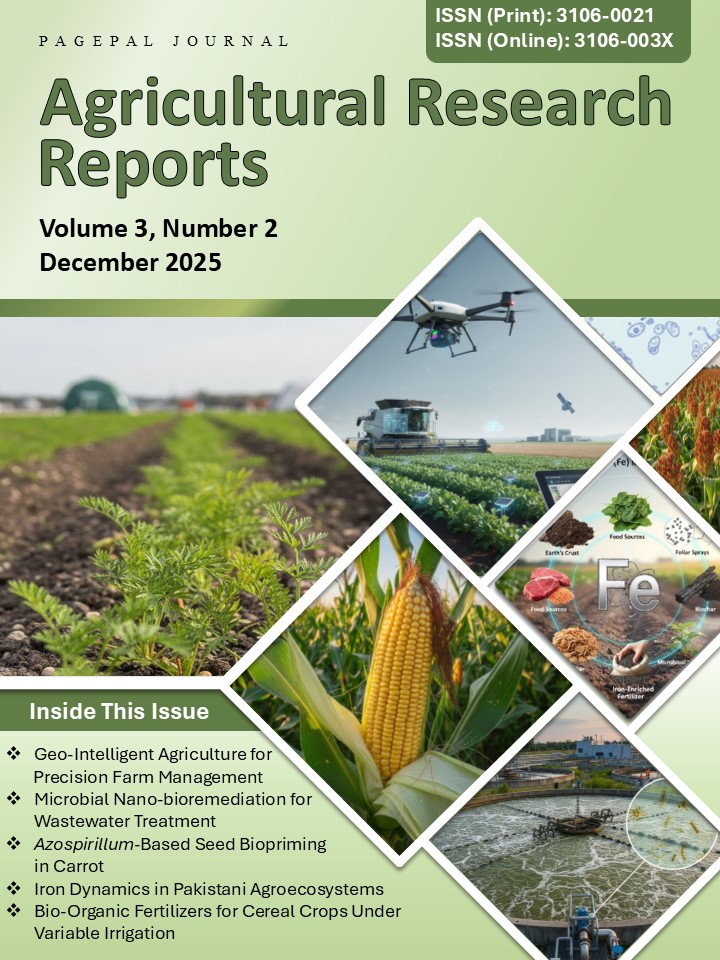
Vol. 3 No. 2 (2025)The December 2025 issue of Agricultural Research Review (ARR) presents a diverse collection of review and original research articles addressing contemporary challenges and emerging innovations in agriculture, environmental management, and sustainable production systems. This issue emphasizes the integration of advanced technologies, biological solutions, and nutrient dynamics to enhance agricultural productivity and environmental resilience.
The review articles provide comprehensive insights into geo-intelligent agriculture, highlighting the role of GIS, remote sensing, and IoT technologies in real-time soil and crop health monitoring and predictive farm management. Another review critically examines recent advances in microbial nanobioremediation, focusing on the removal of heavy metals and pharmaceutical contaminants from wastewater, underscoring its relevance for environmental protection and agricultural reuse of water resources. Additionally, a detailed review on iron dynamics in Pakistani agroecosystems synthesizes current knowledge on iron availability, soil constraints, and plant uptake mechanisms, offering valuable guidance for nutrient management in calcareous soils.
Complementing these reviews, the research articles report original findings on biological and bio-organic interventions for crop improvement. One study demonstrates the potential of seed biopriming with Azospirillum to enhance carrot seedling growth and stress tolerance, highlighting eco-friendly approaches to improving early crop establishment. Another field-based investigation evaluates the growth-promoting effects of bio-organic fertilizers on sorghum and maize under variable irrigation regimes, contributing practical insights into sustainable nutrient management under water-limited conditions.
Collectively, the articles in this issue reflect ARR’s commitment to publishing high-quality, interdisciplinary research that bridges fundamental science and applied solutions. The December 2025 issue supports the advancement of climate-smart, resource-efficient, and biologically driven agricultural systems, contributing to long-term sustainability and food security.
-
Agricultural Research Reports
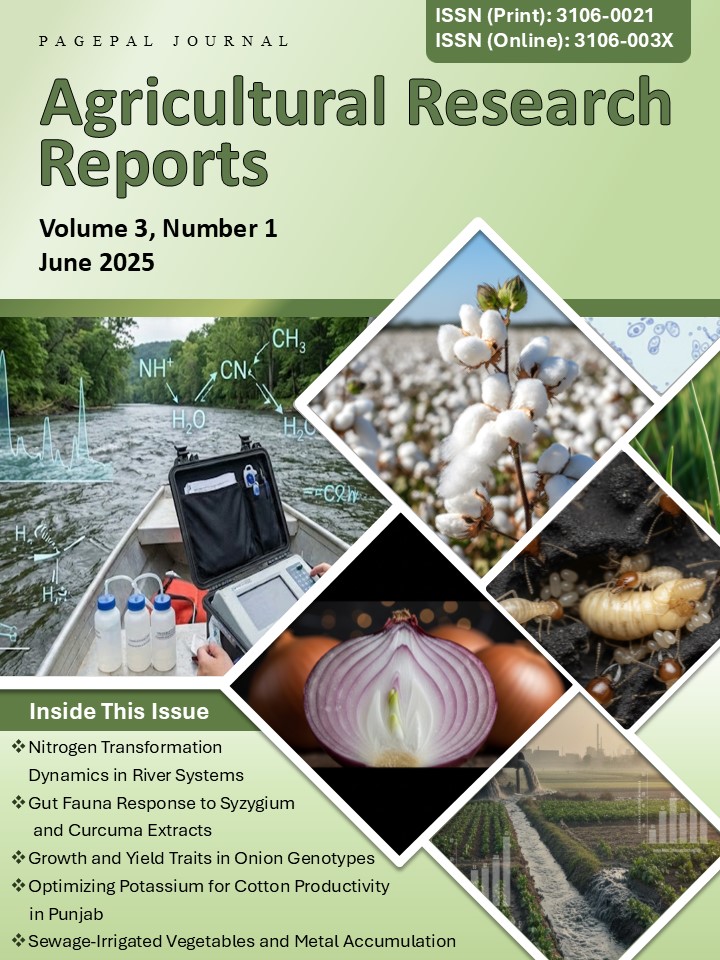
Vol. 3 No. 1 (2025)Agricultural Research Reports presents Volume 3, Issue 1 (June 2025), featuring five original research articles that address critical themes in nutrient dynamics, sustainable crop production, plant physiology, soil–water management, and environmental food safety.
This issue includes:
Modeling the Transformation Dynamics of Organic and Inorganic Nitrogen in Rivers (Research Article) — analyzing microbial-mediated nitrogen transformations and decomposition kinetics to support river water quality assessment and nutrient cycling models.
Effect of Leaf Extract of Syzygium cumini and Curcuma longa on Gut Fauna of Heterotermes indicola (Research Article) — evaluating botanical extracts as eco-friendly alternatives for termite management through their impact on gut microbial communities.
Growth Analysis of Various Onion Genotypes for Yield and Pharmaceutical Traits (Research Article) — investigating genotypic variability in growth, yield performance, and accumulation of pharmaceutically important compounds under field conditions.
Optimizing Potassium Application Timing and Rates for Enhanced Cotton (Gossypium hirsutum L.) Productivity in a Wheat–Cotton Cropping System, Punjab, Pakistan (Research Article) — assessing potassium management strategies to improve cotton yield and system productivity in a major cropping zone.
Effects of Sewage Water Irrigation on Heavy Metals Accumulation in Vegetables in Peri-Urban Areas of Faisalabad, Pakistan (Research Article) — examining heavy metal contamination in soils and vegetables irrigated with untreated wastewater, highlighting potential food safety and public health risks.
Collectively, the articles in this issue provide valuable insights into environmental sustainability, crop nutrition management, plant growth optimization, and food safety, offering evidence-based knowledge for researchers, agronomists, environmental scientists, and policymakers.
-
Agricultural Research Reports
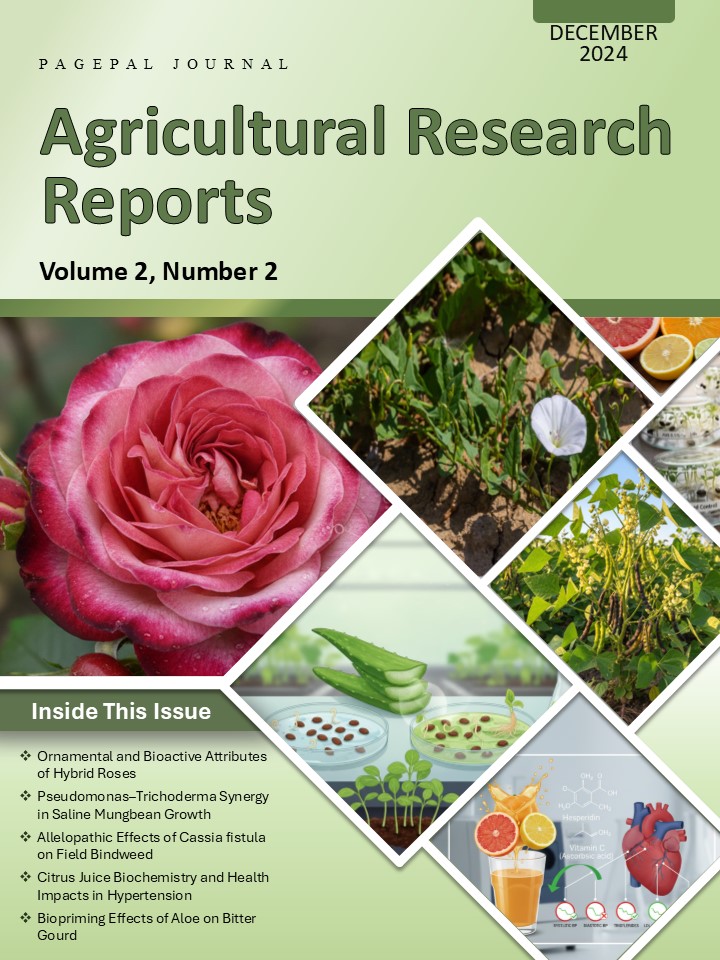
Vol. 2 No. 2 (2024)Agricultural Research Reports presents Volume 2, Issue 2 (December 2024), featuring five original research articles that address key areas of horticulture, crop stress management, biological interventions, and the role of plant-based products in agriculture and human health.
This issue includes:
Multidimensional Assessment of Hybrid Rose Cultivars: From Ornamental Features to Bioactive Compounds (Research Article) — an integrated evaluation of hybrid rose cultivars focusing on ornamental attributes alongside their bioactive and functional properties.
Synergistic Effects of Pseudomonas and Trichoderma on Mungbean Growth and Yield under Salinity Stress (Research Article) — investigating the combined role of beneficial microorganisms in enhancing mungbean productivity under saline conditions.
Allelopathic Potential of Cassia fistula Aqueous Extract in Suppressing Germination and Growth of Field Bindweed (Convolvulus arvensis) (Research Article) — assessing the use of plant-based allelopathy as a natural and sustainable weed management strategy.
Assessing Biochemical Composition of Citrus Juice and its Health Impact in Hypertensive Adults (Research Article) — examining citrus juice biochemistry and its implications for managing hypertension and promoting human health.
Aloe Vera Leaf Extract as a Biopriming Agent to Improve Germination Performance in Bitter Gourd (Momordica charantia) Seeds (Research Article) — evaluating aloe vera extract as an eco-friendly seed priming approach to enhance germination and early seedling vigor.
Collectively, the articles in this issue provide valuable insights into sustainable horticulture, plant–microbe interactions, natural crop protection, functional foods, and environmentally friendly seed technologies, offering practical and scientific value to researchers, practitioners, and policy stakeholders.
-
Agricultural Research Reports
Vol. 2 No. 1 (2024)Agricultural Research Reports presents Volume 2, Issue 1 (June 2024), featuring one original research article and four review papers that explore plant stress physiology, crop improvement, soil fertility, and sustainable agricultural practices.
This issue includes:
-
Molecular Insights into Maize Resistance to Drought and Nitrogen Deficiency (Review) — a comprehensive review of genetic and physiological mechanisms that enhance maize resilience under water and nutrient stress.
-
Interdisciplinary Approaches to Mitigate Crop Stress for Sustainable Agriculture (Review) — examining physiological, genetic, molecular, and technological strategies to manage biotic and abiotic stress in crops, including precision agriculture and modern breeding approaches.
-
Silicon–Microbe Symbiosis: Redefining Plant Stress Adaptation (Review) — a detailed review of how silicon and plant growth-promoting rhizobacteria interact to alleviate abiotic and biotic stresses, highlighting their combined potential for sustainable crop resilience.
-
Impact of Indole-3-Acetic Acid and Naphthalene Acetic Acid Foliar Application on Onion Growth with or without Mulching (Research Article) — a field-based study assessing the effects of auxin applications and mulching on onion growth and development.
-
Boron Deficiency in Pakistani Soils and Its Impact on Cotton Physiology (Review) — a critical analysis of boron deficiency in soils and its consequences on cotton growth, yield, and physiological functions.
Collectively, the articles in this issue provide valuable insights into plant stress management, crop nutrition, growth regulation, and soil fertility, serving as a resource for researchers, agronomists, and policymakers seeking sustainable solutions in agriculture.
-
-

Agricultural Research Reports
Vol. 1 No. 01 (2023)Agricultural Research Reports proudly presents its inaugural issue (Vol. 1, No. 01, December 2023), featuring diverse and impactful research contributions addressing current challenges and opportunities in agriculture.
This volume includes:
-
Yield Assessment of Bread Wheat under Planned Nitrogen Management — exploring how optimized nitrogen regimes enhance wheat productivity.
-
Moringa Leaf Extract as an Eco-friendly Priming Agent — demonstrating its role in improving bitter gourd seed germination and early growth.
-
Unraveling Extinction and Ecosystem Impacts — a critical analysis of biodiversity loss and its cascading ecological effects.
-
Utilization of Kitchen Waste for Potted Vegetable Production — highlighting sustainable waste management and home-based food security practices.
-
Economic Analysis of Cotton Sowing Methods in Punjab — evaluating profitability and efficiency of different planting techniques for cotton growers.
Together, these studies provide scientific insights into sustainable crop production, eco-friendly practices, biodiversity conservation, and economic perspectives—making this issue a valuable resource for researchers, practitioners, and policy makers in the agricultural sciences.
-